Every day, our bodies protect us from potential threats. Our skin keeps out pathogens. Mucus traps bacteria. These barriers are essential, but they can also prevent medicine from reaching the places it needs to go.
At the University of Colorado Boulder, 2022 Packard Fellow Wyatt Shields and his team are working to address this challenge with microscopic robots that could one day deliver drugs or genes to targeted sites in the body. The ability to guide treatments right where they need to go could make them more effective with fewer detrimental side effects.
"The idea with microrobots is that we can change the script. We can essentially direct where these drugs go more specifically and that way we can keep people safe."
Wyatt Shields, 2022 Packard Fellow
Shields’ lab works at the intersection of materials science, biology, and physics. The microrobots they’re developing are tiny particles that can move themselves or change shape and size in response to a magnetic field, acoustic signals, or electric pulse. The scientists can also direct the bots via light or thermal signals. These signals would allow health professionals to control the particles from outside the body, making the procedure less invasive than current surgical treatments.
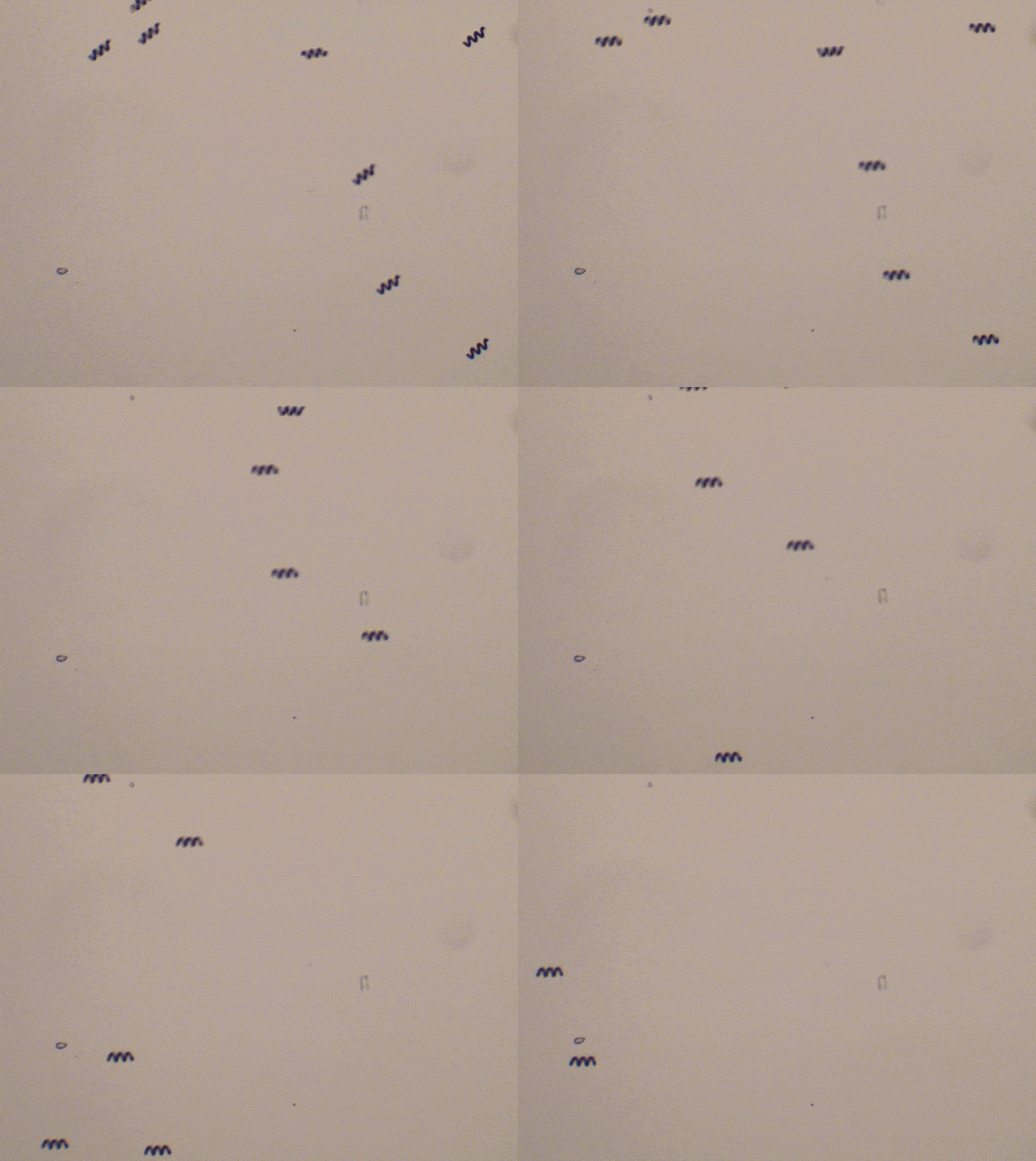
The particles themselves are diverse. Some are microscopic corkscrews that spin in response to a magnetic field to move through the body and even drill into the tough exterior of tumors. Others are like long chains of cubes that can unfold to release medicine or therapies.
Shields’ lab is also experimenting with “cyborg” approaches where a microrobot could hitch a ride on immune cells already flowing through the bloodstream to inflamed areas of the body. For treatments like chemotherapy where powerful medications travel through the bloodstream to reach cancer cells anywhere in the body, targeted delivery via microrobot could reduce the harmful side effects to places in the body that don’t need treatment.
“Local delivery is really quite powerful because it addresses the problem of off target toxicity,” said Shields. “If you can locally deliver a robot containing a drug to the environment of interest, it spares a lot of the rest of the body where you could have toxic effects.”
In addition to drug or gene delivery, these particles could be used as biosensors for monitoring hard-to-reach places in the body. Shields’ lab is testing out biodegradable materials so that the bots could dissipate once their job is done.
Shields received a Packard Fellowship for Science and Engineering in 2022, which provides $875,000 over five years with flexibility in how the funds are used. The Fellowships were inspired by David Packard’s passion for science and engineering and his commitment to strengthening university-based science and engineering programs in the United States. Recognizing that the success of the Hewlett-Packard Company, which he co-founded, grew from breakthroughs in university labs, the Fellowships were founded to seed the experimentation and discoveries that would lead to the innovations of the future.
For Shields, when his team discovered their robots had unique capabilities for delivering genes through mucus, the flexible funding allowed them to pursue that discovery immediately.
“Because of support from the Packard Foundation, my lab’s been able to integrate students and postdocs from different areas and backgrounds, like material science and engineering, biology and physics,” said Shields.
By supporting scientists like Shields when they are early in their careers, the Packard Fellowships allow scientists to explore unproven paths and experiment with new ideas to unlock innovation. Shields hopes to test his team’s new particles in clinical trials so that they can better treat disease. In the future, these microrobots could fundamentally change how treatments are administered and improve people’s health in radical new ways.