Public data are part of the invisible infrastructure that nonprofits, researchers, and philanthropy rely on. As datasets are altered and data infrastructure weakens, philanthropy has a critical role to play in protecting the information that grantees and communities rely on every day.
We all make decisions based on public datasets that have been quietly maintained and analyzed by federal agencies for decades.
In our daily lives, this looks like checking a weather app before planning our day, informed by the National Weather Service’s datasets. Or throwing out foods that have been recalled, based on information collected by the FDA’s Food Recall Database. And relying on the Census Bureau to help communities determine where to build everything from schools to grocery stores to hospitals.
As grantmakers, we use data to gain insights into problems, identify disparities, and design and test solutions. We recognize that our grantees also need up-to-date, reliable data to shape their strategies and understand their impact.
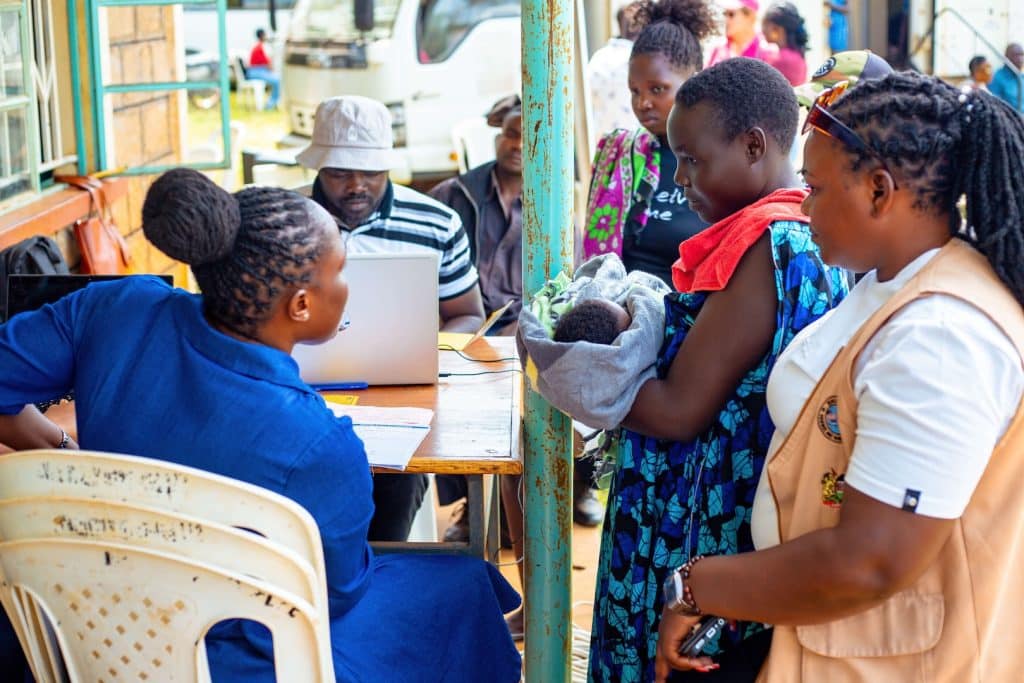
For example, if you fund health care, your grantees may rely on federal datasets to understand where coverage gaps exist and hold systems accountable for closing them.
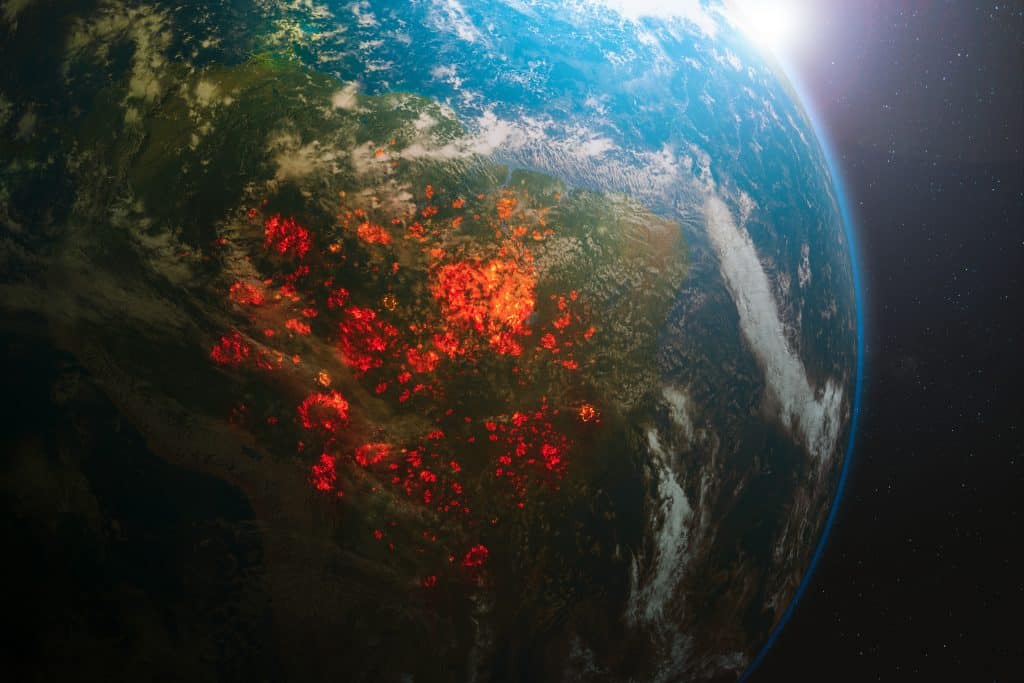
If you fund climate work, your grantees may be using federal data, assessments, and tools to identify which communities face the greatest threats from marine heat waves, sea level rise, fires or deforestation to design and test solutions in partnership with impacted communities.
Community-based organizations use federal data to understand what is happening around them and decide where help is needed. For example, a voting rights-focused grantee may check federal data to understand who was purged from the polls, while a housing stability grantee may look at data to understand over crowdedness and displacement. These are just a tiny sample of the kinds of decisions made possible by federal data — the invisible scaffolding beneath the work our grantees do.
A Changing Data Landscape
In 2025, that infrastructure began coming apart. Federal policy changes targeting data on gender identity, equity, and climate, resulted in dozens of datasets being terminated, and hundreds of data variables being removed. Public access was restricted to web pages and the digital tools researchers use to extract and interpret the data.
The losses go past the datasets. Advisory committees were disbanded. Statistical agencies lost 20 to 30 percent of their staff, and with them decades of knowledge about how these numbers are built, maintained, and read correctly.
Data can be restored, but a trained workforce takes years. Most of the damage won’t show up until the numbers we do have start to look strange, and no one is left who can say why.
The deeper risk is the loss of the infrastructure that makes public data possible in the first place: experienced federal staff, contractors, advisory committees, technical assistance, standards, secure systems, and the long chain of relationships through which local and state data flow into national datasets. A dataset can still appear online while the capacity to collect it consistently, maintain its quality, interpret it, and make it usable is deteriorating underneath it. We may not fully see the consequences for several years.
People who worked closely with federal data knew this was coming. At the end of 2024, Denice Ross, the Chief Data Scientist of the United States at the time, gathered a small group of colleagues at her dining room table, took the pictures off the walls, and covered them with sticky notes, mapping out what might happen to federal data and what they could do about it.
“There was this narrative about how researchers were going to be harmed by the loss of these data. But really every corner of our lives and livelihoods will be touched if these data disappear."
Denice Ross, Director of Federal Data Policy, Federation of American Scientists
The most visible changes since early 2025 have been dramatic: datasets altered, discontinued, websites taken down, questions eliminated, and tools withdrawn. Those acute shocks matter. But what concerns us the most is the quieter form of erosion underneath them. Every organism on Earth exists in constant negotiation with others whether by eating them, sheltering them, or competing with them. Li studies how those relationships alter the course of evolution.
“There’s no way that philanthropy can replace the role of the federal government in producing data,” said Ross. “But, there are opportunities where philanthropy can help protect the most important datasets.”
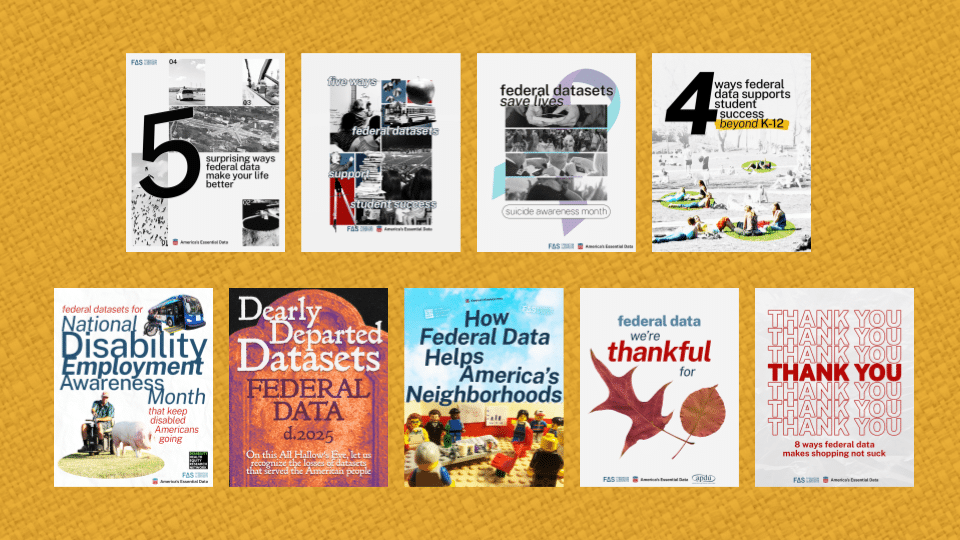
Ross is among the people who understand this landscape best. She now directs federal data policy at the Federation of American Scientists, where she monitors changes to federal datasets through DataIndex.us and documents their real-world value through America’s Essential Data.
Recognizing the urgency, networks of librarians, career data scientists, and civil society organizations moved quickly to protect public data and the infrastructure needed to keep it usable.
The Effect on Our Grantmaking and Our Grantees
We both arrived at the same concern about how these data issues would affect our grantees and our own grantmaking from different directions. In the Packard Foundation’s work that focuses on learning and evaluation to inform grantmaking strategy, we need to know baseline conditions and be able to measure change against them. If communities are left out or data availability differs from year to year, you cannot say whether anything moved. For example, for our grantmaking, we need numbers collected and maintained at the lowest unit – county or neighborhoods – and with demographic details such as race/ethnicity, disability status, gender, and age. These datasets are the first thing to give when an agency loses staff or with administrative orders on processing methods. The communities with the most at stake tend to be the ones the data already saw least clearly. Data on maternal health disparities, where children lack access to adequate services, and on which neighborhoods carry the heaviest environmental burdens, are also those most likely to be affected by the changes.
That isn’t just an inconvenience for researchers. It means funders across the field are then investing in programs without the information they need to assess whether those investments are making a difference.
Some of our science grantees work at the frontier of research, building on decades of federally maintained datasets and environmental monitoring systems that form the bedrock of the scientific record and enable accurate forecasting that affects everyone. When those systems degrade or go dark, it breaks continuity that makes long-term research possible and constrains our ability to predict what’s coming. For example, researchers used data from more than 900 Ocean Observatories Initiative sensors to understand how marine heat waves affected commercial fisheries, and how rising sea levels triggered coastal flooding in northeastern states. These and other insights that relied on the Observatories’ decade of data were threatened by premature removal of the sensors. Similarly, when the extreme weather database was shut down it ended collection of data used by planners, researchers, and decision-makers for state and community risk management and planning.
A Coordinated Response, and What Comes Next
Recognizing the need for a coordinated response to the erosion of federal data infrastructure, the Packard Foundation provided $7.5 million in support for organizations working on preservation, monitoring, and advocacy and public engagement. These grantees included the Environmental Data and Governance Initiative, which worked to preserve critical federal data and tools and make them accessible to environmental justice communities and the public; as well as the Population Reference Bureau’s Federal Data Forum, a hub for public data users to share real-time information about threats to federal data and coordinate responses.
We also supported the Federation of American Scientists’ DataIndex.us, Intertidal Agency, the Open Research Community Accelerator, and other organizations working to preserve, defend, or rebuild data infrastructure.
We joined Funders for the Future of Public Data — a growing funder collaborative —working to coordinate the immediate response and support data practitioners in drafting a long-term plan for a more resilient public data infrastructure.
These opportunities include funding the replacement of smaller, individual surveys, research tools, and datasets, or supporting the building of new infrastructure models for how data is hosted and maintained.
Some data can only be collected at the scale and with the authority the federal government holds. The goal isn’t to replace what federal agencies do, it’s to look at what data does for our society and make sure that it’s protected, collected consistently, and is accessible and usable for those who need it. What began as an acute crisis has become a chronic one.
Public Data Is Essential Civic Infrastructure
Like any infrastructure, it requires sustained investment to remain usable. This moment is also an opportunity to ask harder questions about whether these systems were ever as accessible or resilient as they needed to be, and to bring in the resources needed to build something better together.
If we want our communities — and all of us — to be able to make informed decisions about our health, families and homes, we need a healthy data system that is accurate, accessible and designed to serve the public.
For other funders, the invitation is not to become a “data funder.” It is to understand the data infrastructure your mission already depends on. What information do your grantees use to understand the problem, identify who is being missed, make decisions, and measure progress? Who produces it? What people, systems, standards, and tools keep it usable? Where are those dependencies becoming fragile? Increasingly, data resilience may need to become part of how we think about the durability of work in health, climate, children and families, democracy, science, and other fields.