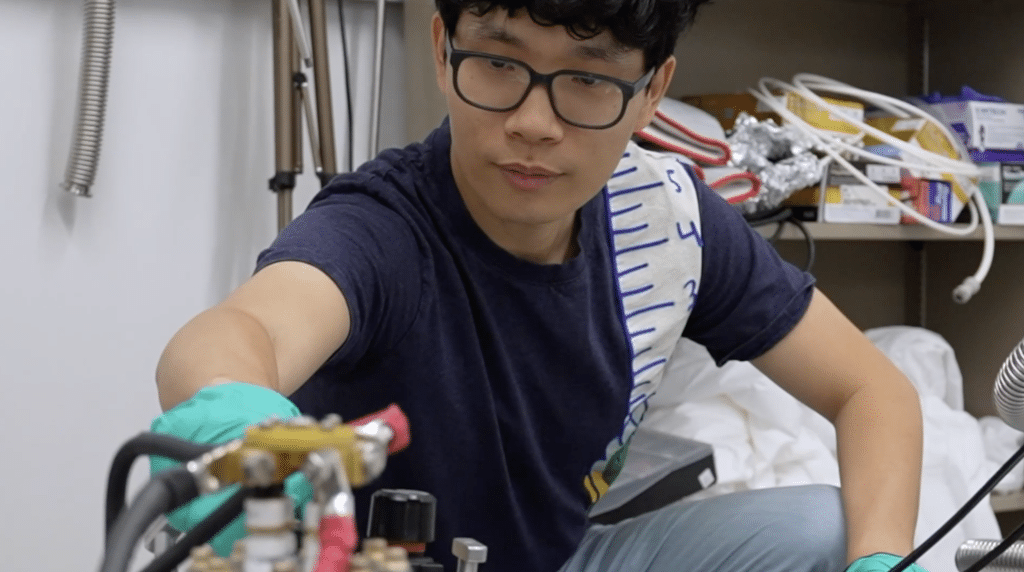
Jingchun Li, a 2019 Packard Fellow at the University of Colorado Boulder, studies how giant clams house algae inside their own bodies to convert scarce underwater light into food, research that could inform more efficient farming and solar energy and was made possible by the Fellowship's flexible funding.
When many people think of animals, they probably first picture the classic ones – dogs, cats, birds, fish.
But vertebrates account for only about three percent of animal diversity in the world. Most animals are invertebrates, and nearly every branch of the animal family tree traces back to the ocean. So, Packard Fellow Jingchun Li’s perspective is that, if you want to understand how animals evolve and adapt, you need to look at the ancient creatures in the ocean.
As the curator of invertebrate zoology at the University of Colorado Boulder Museum of Natural History, Li is surrounded by collections of clams, snails, mussels, and their relatives to study and share with the public.
Li is also an ecologist and evolutionary biologist investigating how living things shape one another.
“I'm interested in the diversity of organisms in the world and how they evolve. But if you want to understand that, you need to realize no organism is living in isolation."
Jingchun Li, 2019 Packard Fellow
Every organism on Earth exists in constant negotiation with others whether by eating them, sheltering them, or competing with them. Li studies how those relationships alter the course of evolution.
One of the relationships that Li has studied most is that of giant clams and how they grow algae inside their bodies for food.
A giant clam takes in algae as a larva, while it is still drifting through open water, and then grows a system of tubes out of its own stomach to give the algae a home. The relationship pays off because the algae turn sunlight into sugar that the clam can consume. Meanwhile, the clam supplies shelter and nutrients in return.
The clams can live and grow this algae up to 20 meters underwater, where sunlight is limited. They compensate with a set of adaptations that concentrate the light they do get to keep photosynthesis running efficiently. Understanding how that evolved could lend fresh ideas to farming in difficult places, using less land, and capturing solar energy more efficiently.
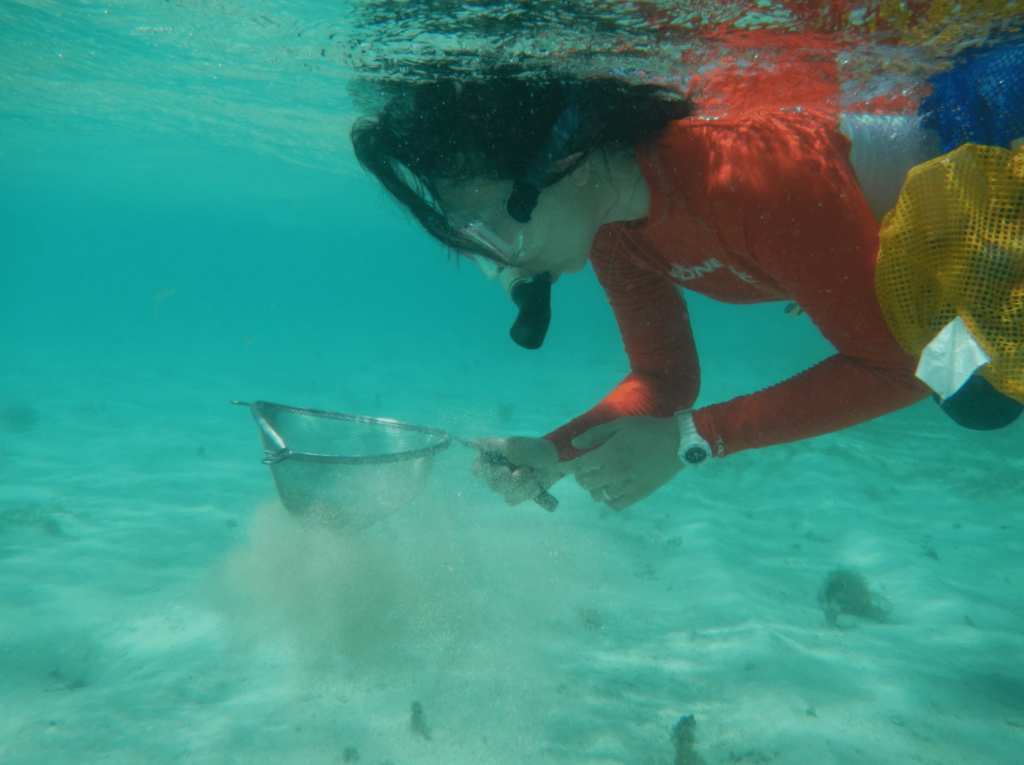
“They have all these different molecular mechanisms to make converting solar energy into organic matter very efficient,” said Li. “If we can understand them, I think it will have a lot of interesting applications in agriculture and in solar panels.”
Li received $875,000 over five years as part or receiving the Packard Fellowship for Science and Engineering in 2019. With no restrictions on how the funds can be spent, the Fellowship is designed this way based on the many breakthroughs and scientific discoveries that began as simple lines of inquiry without a particular outcome in mind at the start.
Li credits the Fellowship with providing her the freedom to support additional students and to pursue ideas outside of her comfort zone that are furthering her research in new ways.
“This allowed me to take on ambitious fieldwork that I otherwise would not do in the early stage of my work,” said Li. “The Fellowship meant I could spend more time in the field and feel safe to explore, and that usually yields a lot of unexpected discoveries and new research directions.”
Learn more about the Packard Fellowships for Science and Engineering.