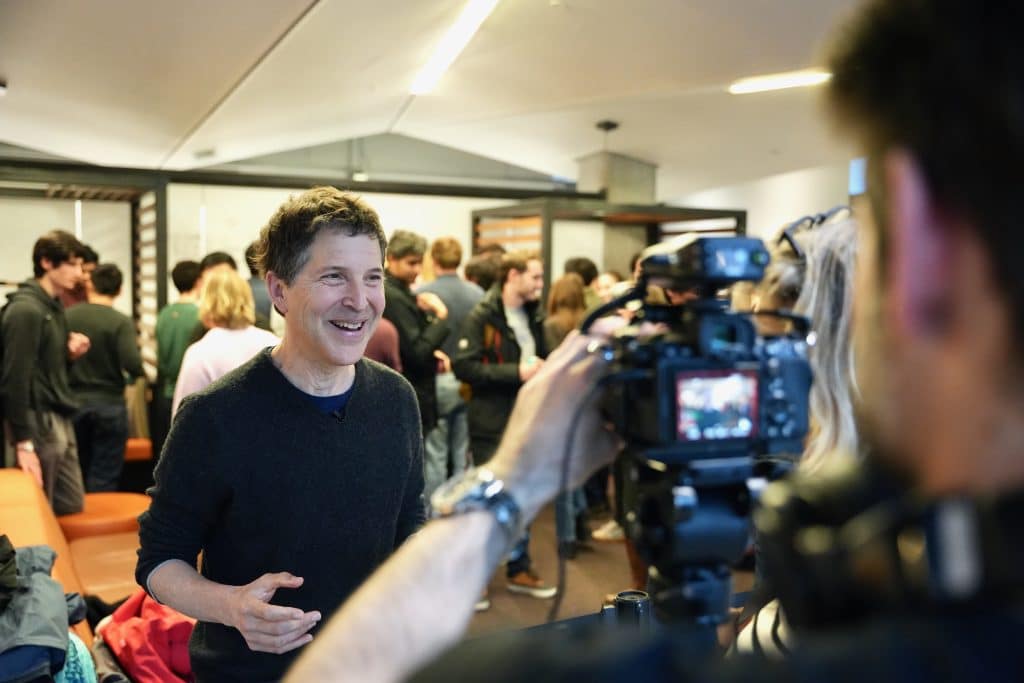
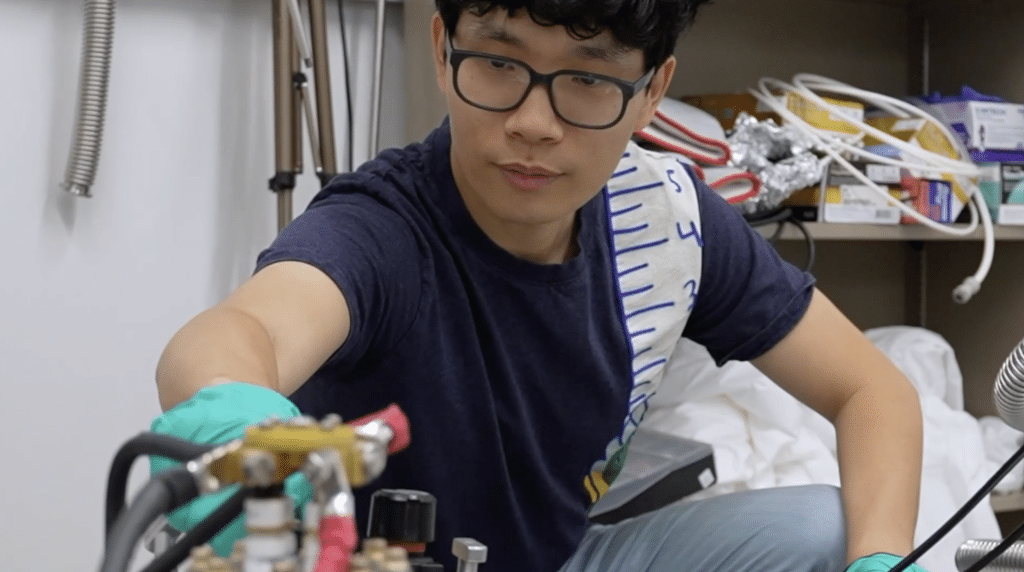
When Dr. Ryan Kelly says he can see whales in a bottle of water, he means it.
At least, he can tell which whales and other species have passed through that water sample by sequencing the DNA inside.
All living things shed tiny traces of DNA in their environments. Water, soil, and even air hold clues about which species have been present. Over the past decade, Kelly and his colleagues have helped bring these genetic traces – known as environmental DNA or “eDNA” — into practical tools for marine conservation. These tools allow scientists to track biodiversity faster and more comprehensively than traditional surveys.
Monitoring wildlife in the ocean or remote freshwater sites is time-intensive and costly. eDNA methods let scientists detect species without ever needing to see or catch them.
The Packard Foundation began supporting Kelly’s work in 2013, when he was part of a team of researchers and engineers first testing whether it was possible to detect DNA that animals shed into seawater.
“I became aware of the idea that you could use DNA in the environment as a signal about what was going on with the animals and the kelp and everything else that lived in the ocean,” said Kelly. “And it felt like this magical key to understand not just patterns of what lives where but actually process how and why things are doing what they’re doing.”
Working with the Monterey Bay Aquarium, Kelly and his collaborators tested the eDNA methods in the Aquarium’s tanks and confirmed that the eDNA sequences matched the known species in the tanks. Scientists at the Monterey Bay Aquarium Research Institute (MBARI) also advised on the work through their long-standing collaboration with the Aquarium.
Since then, the field of marine eDNA has exploded. Kelly and his colleagues have used eDNA to count endangered salmon, map harmful algal blooms, and forecast ecosystem changes in Puget Sound. His lab also works to assess the effect of urbanization on nearshore ecosystems and to generate three-dimensional maps of fish and marine mammals in the Pacific Ocean.
Seeing how the field of eDNA research was developing, Kelly partnered with the Packard Foundation again in 2021 to create the eDNA Collaborative, a worldwide network of eDNA scientists and practitioners. The eDNA Collaborative aims to disseminate, accelerate, and reinforce science that brings eDNA analysis and techniques into routine practice around the world. Based at the University of Washington, it supports ongoing projects, offers small grants to new efforts (particularly in the Global South) and hosts visiting scholars to share methods and solve problems together.
“We wanted to have a way of connecting people so that the best ideas could rise to the surface as fast as possible and then spread as fast as possible,” said Kelly. “We thought a network was the way to do that.”
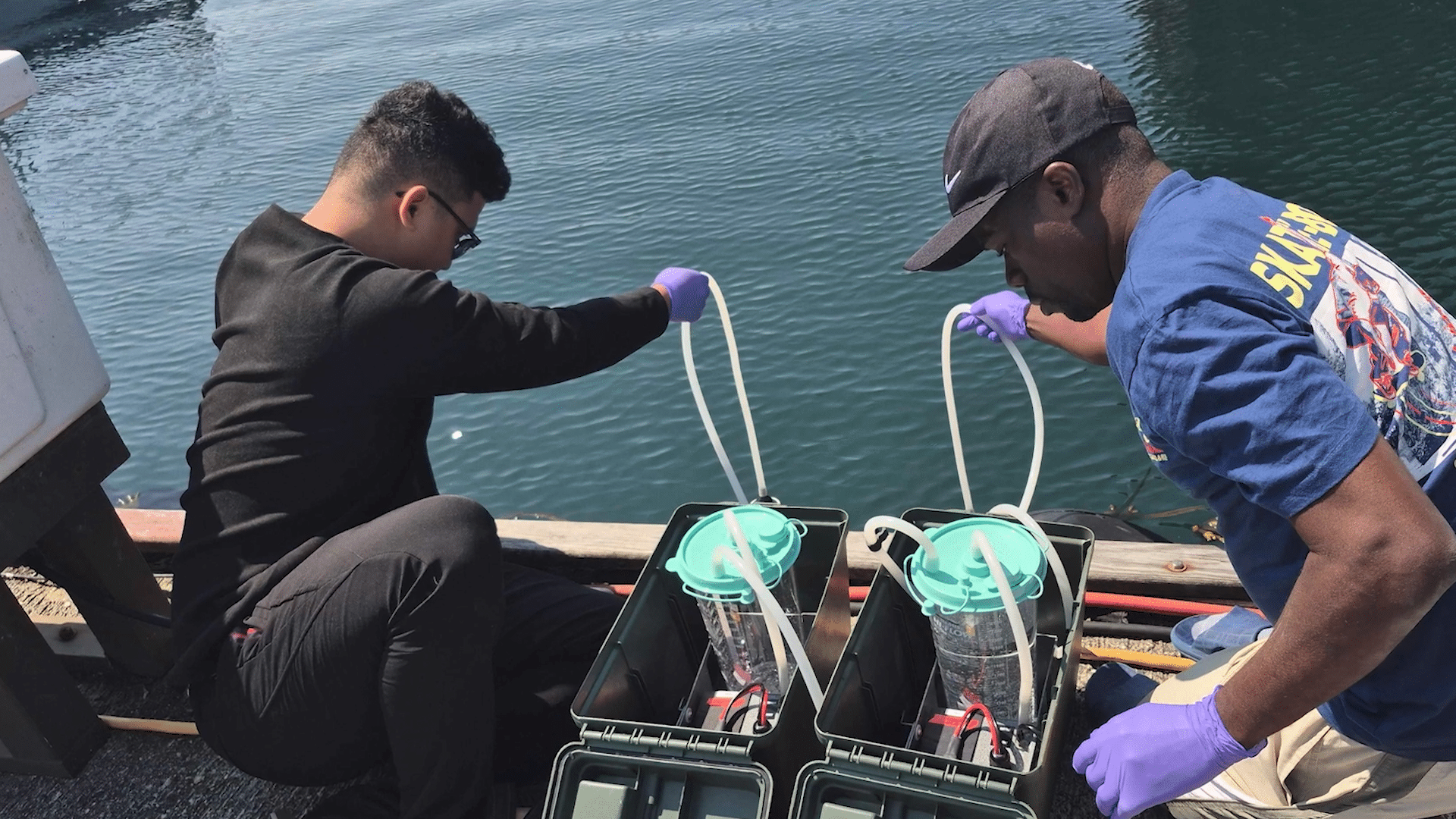
The Packard Foundation has provided $2.5 million in targeted grants to Stanford University and the University of Washington to advance the field of eDNA. Alongside that work, Foundation grantee MBARI has been a major engine of innovation for marine eDNA tools and techniques. The most recent grants to the University of Washington focus on scaling these tools and making them easier to use, without compromising accuracy or reliability.
“The best case with philanthropy is to spark something that wouldn’t have been possible otherwise, and that takes some time,” said Kelly.
Like many scientific advances, eDNA’s evolution shows how long-term investments can transform an experimental idea into a global field.
Kelly envisions a future where eDNA is embedded into global data sets that inform international conservation efforts and sustainability decision making. He draws inspiration from his students, who are finding new ways to apply eDNA to support both people and nature.
“To be able to go from this sort of experimental technique in the Monterey Bay Aquarium and work all the way up and see that get traction on Capitol Hill and in federal agencies to monitor the natural resources, public natural resources of the United States, that’s remarkable,” said Kelly.