As geopolitical shocks and climate impacts continue to reshape lives and livelihoods around the world, climate and development goals are increasingly intertwined. Addressing these priorities together has never been more urgent. The solutions that deliver economic opportunity, build resilience, strengthen energy security, protect livelihoods, and cut emissions are increasingly affordable — and increasingly the same solutions.
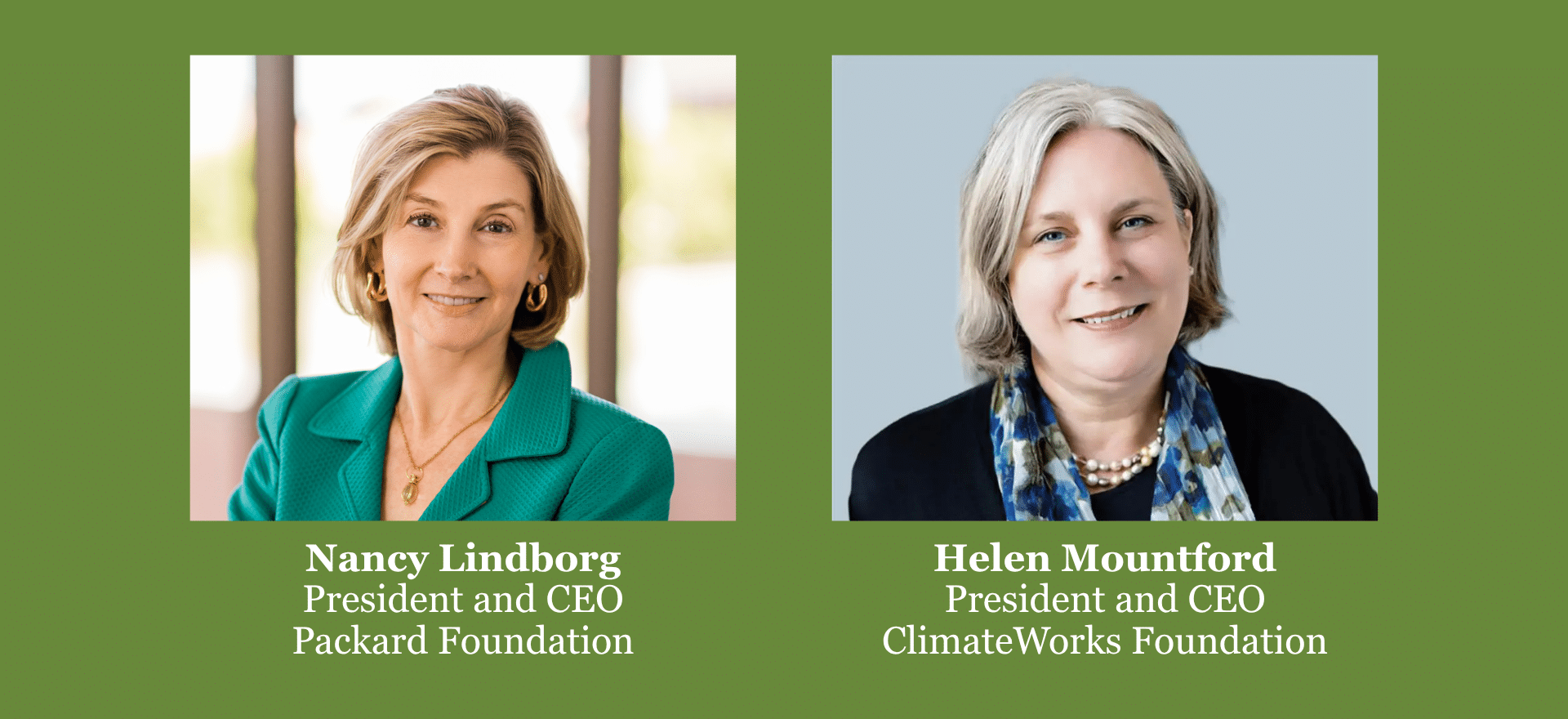
Nancy Lindborg and Helen Mountford have spent their careers at exactly this intersection of climate and development. Lindborg as the president and CEO of The David and Lucile Packard Foundation and incoming Board Chair of ClimateWorks, and brings a lens shaped by peacebuilding, development, and humanitarian assistance. Mountford, president and CEO of ClimateWorks Foundation, has spent more than three decades working at the intersection of climate, economics, and development. Together, they sat down to discuss what it means to fund climate solutions that deliver for people, economies, and the planet, and what keeps them stubbornly optimistic.
On getting started in climate and philanthropy
Helen Mountford: You and I have both taken different paths to climate philanthropy. What motivated you to enter this work?
Nancy Lindborg: Right after college, my first job was working in conservation, land, and energy. However, I didn’t find my way into the climate world when I first started, as I wasn’t a scientist, which at the time I thought was a requirement for that work. Instead, I focused on a decades-long career in development, humanitarian assistance, democracy, and conflict.
Starting in the 2010s, so much of the humanitarian work was about responding to disasters that were climate-related and happening ever faster. Droughts in the Sahel and Horn of Africa that used to occur every 10 years were now happening every couple of years. It became clear that the work I was doing was so connected to climate. When I had the opportunity to join the Packard Foundation, it was a chance to really bring those threads together.
What about you, Helen? What was your path into climate philanthropy?
Mountford: I’ve been working on climate and its link to economic development pretty much all of my career. But what brought me into climate philanthropy was realizing the urgency of this moment, when our biggest priority is accelerating climate action well beyond what we’d thought was possible, and the catalytic role philanthropy can play in unlocking this. I was seeing the impacts of climate change on people and communities around the world and understanding the science of how much worse it will get if we don’t tackle the crisis quickly.
I’d seen in my work with governments, the corporate sector, and civil society that most of the solutions are out there — but they just need the funding to test and bring them to scale much more rapidly. It was clear to me that philanthropy is uniquely positioned to play that catalytic role — to take risks, learn what works, and share it with others.
On the intersection of climate and development
Mountford: Nancy, we’ve worked together for a few years now. Now that you’re stepping into the role of Board Chair, I’m curious: what’s shifted in how you think about the intersection of climate and development?
Lindborg: My background is in the development world, with a very clear perspective on how international infrastructure and dynamics work. You’ve helped me see that climate funding is just as complicated — with its own maze of funding mechanisms and infrastructure — as the development world I came from. And the two worlds run in parallel. This disconnect is visible every September in New York: the UN General Assembly and Climate Week run simultaneously, drawing largely separate audiences despite overlapping stakes and conversations. People are working on the same underlying problems — resources, the future, who pays — and are not in the same room.
Mountford: I’d like to build on that. One of the things we’ve been working on together is realizing that this is not a zero-sum game. When I first came to ClimateWorks, many funders were very focused on climate mitigation alone. There were concerns that focusing on adaptation and resilience would shift funding away from mitigation — the reduction of greenhouse gas emissions.
What you helped me and our board see, Nancy, is that it doesn’t have to be that way. These can be additive. By broadening our focus from emissions reduction to also include adapting to climate impacts, and building resilience into development, we’re bringing in other parts of philanthropy — development, agriculture, food, and health. Together, we’re looking at how to collectively solve these challenges, bringing in more funding to what each of us is trying to do, and achieving much more impact when our efforts complement and reinforce each other.
Lindborg: And sadly, we’re at a point where the development sector’s traditional institutions and operations have been disrupted by deep and sudden cuts. It’s important that we don’t retreat into competition over resources, because there are so many areas where we can both mitigate emissions and build greater resilience for communities that are especially vulnerable to climate impacts. Areas where economic development and the energy transition are intertwined. There’s no possibility of philanthropy filling the gap of lost international development assistance. But we do have models for how philanthropies can align strategies for greater shared impact. ClimateWorks is one example, demonstrating data-driven options for addressing critical problems that philanthropies can either pool money toward or align their strategies toward.
The Forests, People, Climate (FPC) initiative is another example, and it’s one that the Packard Foundation helped create. It’s where climate and development come together: philanthropies, civil society, and community-based organizations all working for shared impact, in alignment with bi-and multi-lateral institutions. Tropical deforestation contributes roughly 10% to 15% of global greenhouse gas emissions, making this work critical to climate mitigation while also protecting forests’ vital role in removing carbon from the atmosphere. FPC aims to halt and reverse tropical deforestation across the world’s critical forest regions and, in doing so, cut global emissions by up to 15% by 2030. So far, FPC has raised more than $1.2 billion toward a $2 billion philanthropic goal — all in service of protecting forests while delivering just and sustainable development.
In a moment of fewer resources, we need to get very sharply focused on understanding that enduring solutions require a systems approach. That’s difficult to achieve when individual philanthropies go in with their one vertical approach.
To me, it’s fundamental to how ClimateWorks thinks about its purpose, and a roadmap for how philanthropy can organize itself going into this fraught period of reduced resources, higher need, and more urgent action.
Mountford: And a systems approach helps ensure the greatest impact for the dollars invested. These solutions don’t just tackle one silo; they achieve multiple aims, and doing so with other foundations and other parts of philanthropy means we’re not duplicating efforts, but building on each other’s work. And by connecting climate action to what people need, to development and growth objectives, we can deliver more ambitious and enduring shifts beyond any individual sector.
On geographic funding trends in climate philanthropy
Mountford: We also need to interrogate: where are our dollars going? Our latest data shows that philanthropic giving for climate mitigation has been increasing — reaching a new high of $6 billion in funding from foundations in 2024, and between $11.7 billion and $18.4 billion when individual giving is included. And initial insights suggest these funding levels held firm in 2025 or even increased, despite significant headwinds.
However, it’s worth noting that of the foundation funding going to a single country or region-specific climate action, 70% goes to the United States and Europe, and only 30% to the rest of the world. While defending the climate progress we’ve seen in the United States and Europe is critical, some of the greatest momentum we’re seeing is coming from the Global South, in communities that are navigating development and climate pressures simultaneously. And funding to support that leadership and the opportunities in those regions is so essential now. Can you point to something specific you’ve seen that changes how you think about what’s possible in Global South countries?
Lindborg: Electric vehicle initiatives really bring this together. Countries like Ethiopia are accelerating their EV transitions — not just as a climate response, but because it means affordable transit, more jobs, stronger energy security, and cleaner air for communities. It really demonstrates what the future can look like in places, including the United States, particularly for people who need access to affordable energy.
Mountford: And the economic story is compelling on its own terms now. In Kenya, for example, delivery workers using electric two-wheelers are seeing their take-home pay increase significantly due to savings on fuel costs. That was true before the recent fuel crisis brought on by the closure of the Strait of Hormuz, and is even more true now. We’re seeing the same with solar and wind. In many of the countries in the Global South where we support action, we’ve really seen a rapid shift in recent years to renewables because they are cheaper and quicker to build. In the current crisis, many of the governments, businesses, and households are now realizing the risks of dependence on imported fossil fuels for energy and transport, with their vulnerability to price and supply shocks, and are rapidly shifting instead to renewables with storage and EVs.
Or, take cooling as an example. There’s so much talk now about the energy demands of AI and data centers, but the IEA expects that new electricity demands for cooling will actually exceed those of data centers by 2030 because of increasing temperatures and extreme heat impacts hitting more regions around the world. Already, nearly half the world’s population endures at least 30 days of extreme heat each year, and those numbers continue to grow, making access to cooling no longer a luxury, but a necessity. In India, a philanthropic initiative supported EESL in aggregating demand for super-efficient fans that use half the electricity of standard models, cutting costs by up to 30%. As a result, their sales took off, with market share tripling. We aim to build similar momentum for super-efficient air conditioners that are optimized for the hot and humid climates where most of the future AC demand will occur.
Lindborg: Both of those examples are seen as mitigation, but they actually reflect an understanding and harnessing of the development aspects. These are exactly the types of opportunities that require different kinds of organizations working together.
On what’s next for climate philanthropy and development
Mountford: While the world is in a challenging place now, there are also reasons for optimism. If you could change one thing about how philanthropy approaches climate and development over the next decade, what would it be?
Lindborg: Philanthropy tends to fund in silos across all issues — agriculture, health, climate, mitigation, and resilience. That’s challenging because it means philanthropy is less likely to think about a place-based approach or to listen more deeply to what communities need and want. We would be well-served to move more toward funding across systems, rather than individual verticals, which often requires collaboratives, shared strategies, or aligned strategies.
For example, one of the unexpected negative impacts of deforestation is the increase in Ebola and other zoonotic diseases that jump from animals to humans. This calls for a rapid response across both the health and climate sectors: conserving existing tropical forests while giving forest communities alternative ways to make a living, so they don’t have to push further into forests and hunt animals that can carry disease – in addition to ensuring we have functioning health systems and data collection capacities.
Mountford: One thing that I’m hoping to see shift over the coming years is increased funding to countries in the Global South, where we’re seeing a lot of opportunities and leadership to leapfrog and accelerate action on climate. Those who want to take on this challenge recognize the opportunities the clean energy transition brings for their people, their economies, and their communities.
Lindborg: That hope echoes the biggest shift I’ve seen in the development world toward locally led solutions. Local communities, organizations, and governments hold the knowledge and the connections that make change last — and for too long, they’ve received only a sliver of the funding. Lasting progress happens when the people closest to the problem are the ones leading the way.