Founded by civil rights lawyer Sherrilyn Ifill, the 14th Amendment Center for Law and Democracy at the Howard University School of Law is the first institution devoted to the amendment that guarantees equal protection, due process, and birthright citizenship.
“We can create the world we want, not the best world we can have based on what we have already seen.”
This conviction inspired Sherrilyn Ifill to establish the 14th Amendment Center for Law and Democracy at Howard University. Like the civil rights lawyers who came before her, whose vision and courage shaped her own career, Sherrilyn believes that the work of advancing justice requires more than defending what exists. It demands the imagination to envision a world not yet realized — and the determination to bring it into being.
That is the promise of reimagining American democracy through the framework of the 14th Amendment: a constitutional vision born of the nation’s second founding following the Civil War, when equality became linked with American citizenship. The challenge today is not simply to reclaim that promise, but to imagine what democracy could become if we finally fulfilled it.
For Ifill, helping the United States live up to the potential of the 14th Amendment starts with educating the public. Americans form their ideas about justice and equality long before they encounter the U.S. Constitution. They absorb them from television, movies, family conversations, and tradition.
Later, they will learn that equality became guaranteed as a right with the 14th Amendment’s equal protection clause. Ratified in 1868, the 14th Amendment was written to secure citizenship and equal standing for Black Americans freed from slavery. It made nearly everyone born in the United States a citizen, required states to give every person equal protection and due process of law, and gave Congress the power to enforce those guarantees. This meant that state governments must treat people fairly, follow proper legal procedures, and apply laws equally to everyone.
“We talk about equality not just because we think it's important and right to treat people equally. We support it because it is written into our Constitution, and we should expect every American to support it and to live by it.”
Sherrilyn Ifill, Founding Director of the 14th Amendment Center for Law and Democracy at the Howard University School of Law
As the founder of the 14th Amendment Center for Law and Democracy at the Howard University School of Law, it is Ifill’s mission to help fulfill the promise of the 14th Amendment as a foundation for a more just, inclusive, and democratic society. Launched in March 2025, the 14th Amendment Center was born at a consequential moment for both constitutional rights and American democracy. The 14th Amendment’s guarantees — including equal protection and birthright citizenship — are being tested in courts and active legislation, and contested in public life, even as trust in the institutions charged with upholding those rights has eroded. Just 17% of Americans say that they trust the government to do what is right, one of the lowest readings in nearly 70 years of polling, according to Pew Research Center.
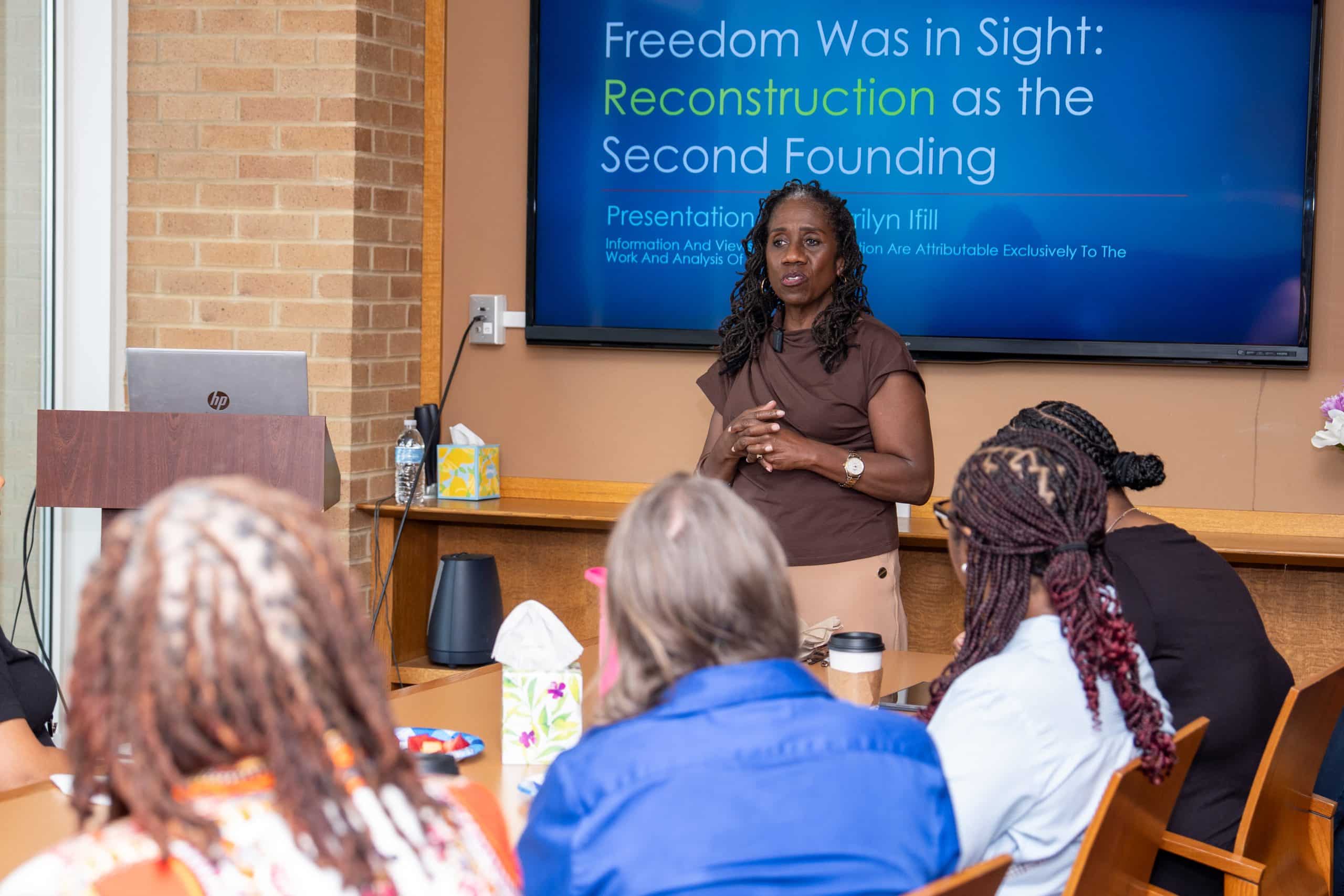
Promoting the 14th Amendment
While the First and Second Amendments have had centuries of strong academic and advocacy support, the 14th Amendment is not comprehensively taught in most law schools and has never had an institution solely focused on its legacy and potential.
“I wanted to create a center where we could begin to do the work of reintroducing or, in many cases, introducing Americans to the constitutional underpinnings of the demand for equality and equal treatment,” said Ifill. “Just as we don’t think people need a law degree to know about the First Amendment, I want that for the 14th Amendment.”
Ifill has been steeped in 14th Amendment work for years. In addition to running the Center, Ifill serves as the Howard University School of Law Vernon Jordan Jr. Distinguished Professor of Civil Rights. From 2013 to 2022, she led the NAACP Legal Defense Fund as president and director-counsel, the organization that argued Brown v. Board of Education and has helped shape the meaning of the equal protection clause for more than eight decades.
The Wide Reach of the 14th Amendment
The 14th Amendment was initially conceived to protect Black Americans after the Civil War. Courts have since applied it far more widely to include women, people with disabilities, LGBTQ+ people, immigrants, and others affected by discrimination. Courts have relied on it in cases involving gender equality, reproductive rights, and marriage equality. The Center’s goal is to teach that history and to ask what else the amendment could deliver. Ifill believes that when people understand the 14th Amendment, they are far more likely to use it to promote a more equal and fair democracy.
“The 14th Amendment includes soaring promises and high-minded ideals, as well as the clear-eyed pragmatism needed to provide real and practical tools to protect against the threats that the authors knew would likely seek to unravel the republic they envisioned,” said Ifill.
The Center approaches this work in four ways.
Law and Policy: The Center’s team files amicus briefs in select 14th Amendment cases and briefs lawmakers on the provisions that Congress can enforce, supporting litigation brought by others rather than bringing its own. When an executive order challenged birthright citizenship, the Center ran public webinars explaining the provision, and Ifill’s students helped research for an amicus brief. The Supreme Court ruled the order unconstitutional in June 2026.
Education, Curriculum, and Scholarship: The Center is publishing an open syllabus for Ifill’s seminar so other law schools can teach the course, and Ifill runs sessions on the amendment for federal judges, judicial clerks and K-12 teachers.
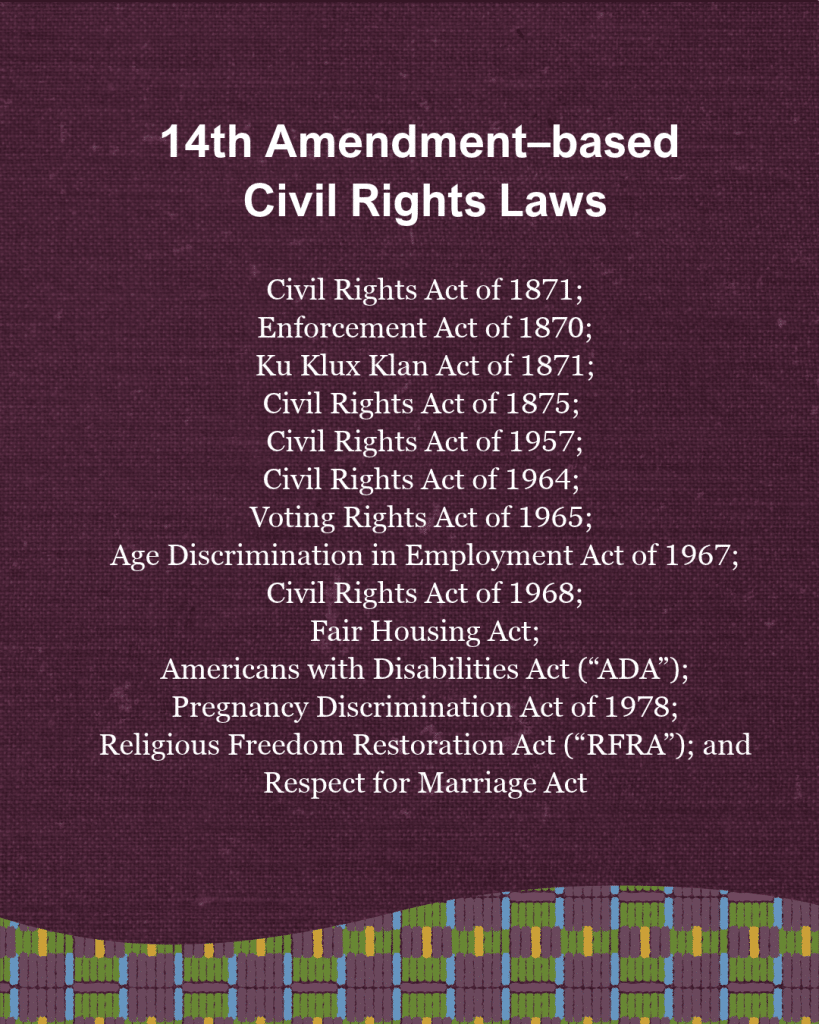
Art, Imagination, and Narrative: Americans absorb most of their sense of national identity through culture , so the Center brings artists together with lawyers and policymakers to create new work about the amendment’s promise, and to strengthen the use of imagination in democracy-building..
Democratic Institutions: Because U.S. democracy depends on strong institutions that protect citizen rights, the Center works with the people who lead them to promote understanding and engagement with the 14th Amendment, including corporate and faith leaders whose organizations benefit from the amendment’s protections, but for whom a set of obligations to the values of the Amendment should be developed.
A Dedicated Center
The Packard Foundation supported the 14th Amendment Center with a $1.5 million, three-year grant in 2025. The Center’s work helps us make progress toward the Foundation’s goal to protect civil rights and accelerate progress toward justice and equity for Black people and communities.
"The 14th Amendment guarantees equal protection, and a key part of our racial justice work is making sure that guarantee is more than words on paper. We support partners building the public understanding and the community leadership that make sure that this constitutional promise is fulfilled through laws, policies, and practices."
Meshie Knight, U.S. Racial Justice Initiative Director at the Packard Foundation.
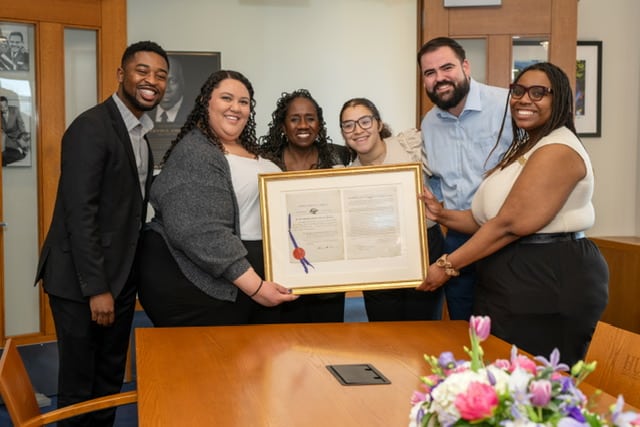
The 14th Amendment requires people to be counted for congressional representation and provides the constitutional foundation for equal protection. In addition to the Center, as part of its 14th Amendment-related grantmaking, the Packard Foundation is a part of the Census Funder Collaborative, a group that pools and aligns resources for census policy and operations, research, collaboration, and outreach, all with a focus on communities that are persistently undercounted in the census and American Community Survey, including people of color, young children, immigrants, low-income households, rural communities, and others.
The Packard Foundation also supports TechTonic Justice, an investment in exploring AI as the next frontier for civil rights and economic justice— how we protect the public from algorithmic harms in housing, employment, healthcare, K-12 education, and public benefits.
In addition, the Packard Foundation supports PolicyLink’s work to build a nation capable of delivering the promises of the 14th Amendment. American democracy is not about a singular founding moment; it is about the ongoing work to expand the promise of equal protection.
Building a more equal future has been done before in the United States, after the Civil War, by people with no assurance it would work. When the states ratified the 14th Amendment in 1868, equality was written into the Constitution for the first time. Today, it is up to the lawyers, policymakers, and the public to decide whether it holds, and whether the amendment keeps building toward a more just and equitable society.
Just as everyday people have always driven progress, we are invited to claim the 14th Amendment as fully as the First and recommit to the promise of equality.