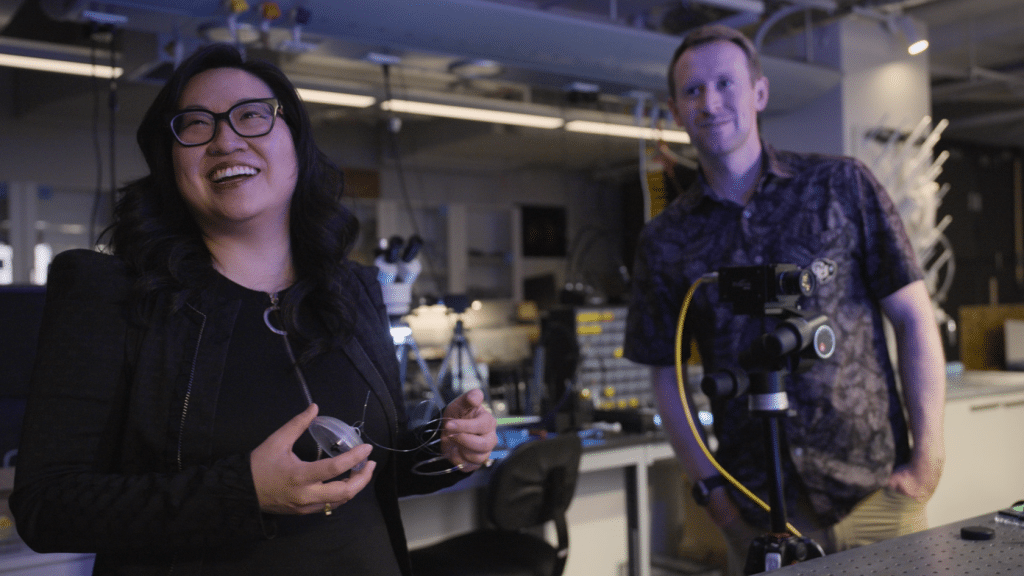
Jamaica Maxwell and Nigel Sizer spend a lot of time thinking about what it takes for progress to take root and endure.
Jamaica leads our Civil Society and Leadership initiative, which invests in civil society, the sector of society where individuals, organizations, and movements come together to create positive change, as well as efforts to create and maintain a safe and open civic space where leaders and organizations can freely and safely do their work. Civic space in many countries, including the United States, is under threat, making it harder for leaders and organizations around the world to organize, speak out, and shape the decisions needed to address the climate emergency and other crises.
Nigel sees these challenges firsthand in his work leading our Global Climate initiative, which aims to halt and reverse tropical deforestation. Protecting tropical forests is one of the most beneficial and immediate ways to slow climate change. Keeping forests standing depends on people and communities having the rights and freedom to participate in decisions, protect their lands, and hold governments and businesses accountable.
That’s why Jamaica and Nigel work closely together at the intersection of civic space and how it supports climate action.
They sat down during the U.N. General Assembly and Climate Week in New York City to discuss what they were hearing and to reflect on why climate progress and civic space go hand in hand.
Their conversation has been edited for length and clarity.
Jamaica: We’ve crossed paths on the streets and in conference rooms all over New York City this week. I’m glad we finally have a chance to sit down and compare notes.
Nigel: Me too. I think I’m closing in on 100,000 steps this week. I love it when work doubles as a workout.
Jamaica: That’s impressive, though I can’t say I’m surprised.
Nigel: But we’re not here to compare step counts. Tell me, what’s coming up most often in your conversations this week?
Jamaica Maxwell: In many of the conversations I’ve been in with peer funders, grantees, and experts, we’ve challenged ourselves to move beyond reacting to everything coming at us to embarking on a new level of cooperation and collaboration where we can accelerate progress on important issues.
I think the shock to the system in 2025 – the disruption to global development and cooperation – pushed groups working on climate, development, and civil society together in new ways. Of course, these issues have always been intertwined. Climate shocks can undermine development progress and development choices impact emissions and resilience. But governments, funders, and organizations have been working on these issues in silos, despite efforts over the years to break down those barriers. This year in New York, there were more discussions at the intersection.
What has been a highlight for you?
Nigel Sizer: Getting to meet our partners in person, like the groups that have been at the forefront of reducing deforestation and are succeeding in places like Brazil and Indonesia.
Jamaica: I’m curious, what do you think made that progress possible?
Nigel: The success is the result of a concerted effort by political leaders, technical experts, Indigenous Peoples and local communities, civil society organizations, and others. Our partners have also secured commitments from companies to do more to address deforestation in supply chains for commodities like beef and palm oil.
Civil society organizations have been instrumental in securing these climate wins. While there are limitations, groups in Indonesia and Brazil have the resources and freedom to organize, advocate, and hold institutions accountable. And we’re starting to see similar momentum in the Congo Basin where our partners are strengthening collaboration and building greater capacity to influence decisions affecting forests and communities.
Jamaica: That’s really encouraging, but it raises a hard question for me. Today, 72% of the world’s population lives in countries where civic space is repressed or closed. What does that mean for climate progress?
Nigel: As these pressures grow, climate funders must broaden how we think about climate solutions. It’s not enough to invest in specific policies, technologies, or campaigns. We must also invest in the conditions that enable progress.
Brazil and Indonesia clearly show us that to make change, civil society leaders and organizations need to be able to hold governments and businesses accountable for their actions. To drive science forward into policymaking and insist that it sticks. To work together to find solutions. That’s how they can sustain their efforts in increasingly difficult environments.
Jamaica: That word “sustain” is important. Funders and civil society organizations spend a lot of time achieving progress but are not always focused on what it takes to make it last. I’ve been reflecting on some of the policy gains we’ve seen rolled back in recent years and wondered what might have made them more durable.
Nigel: Do you have a working hypothesis?
Jamaica: I come back again and again to strong civil society – which is how citizens organize to make their voices heard and hold governments accountable to the policy promises that have been made. When civil society leaders and organizations lack the resources and freedom to organize, climate progress will be hindered, fragile, and likely temporary.
This is not just about individual organizations or formal civil society, but also about supporting the coalitions, networks, and movements that allow people to come together when progress is under threat. Strong civil society and the ecosystem that sustains it cannot be built through a one-time investment, but instead require a long-term commitment to the strength of civil society in a given place.
Nigel: I couldn’t agree more. I’ve been meeting this week with partners from the Congo Basin, including organizations working in places where activists have been detained for peacefully protesting. I’m always inspired by how they adapt and keep finding ways to make progress, and of course their courage.
Jamaica: And that’s why security and protection support is critical. People need resources to stay safe and respond when threats arise. But protection alone isn’t enough. They also need the basic rights and freedoms that allow them to do their work: to speak out, organize, participate in decisions, and hold governments and businesses accountable.
Nigel: And that is directly relevant to protecting tropical forests. Some people might be surprised that an initiative focused on forests supports organizations working primarily on human rights.
But for us, that isn’t separate from the climate strategy. Defending the rights of Indigenous Peoples, Afro-descendant communities, and local communities who have cared for their lands for generations is one of the most powerful strategies we have to keep forests standing. Supporting their land and resource rights, and their voice in decisions affecting their territories, advances climate action while also sustaining livelihoods and strengthening community decision-making.
You can see the results on a map of the Brazilian Amazon. If you overlay Indigenous territories, you can see enormous areas of intact forest, most of which are territories where the local communities’ rights to manage and protect the forest are recognized by the national government.
You’ve been doing this work for a long time, Jamaica. What advice would you give to a funder just starting to explore funding support for civic space?
Jamaica: I’d say start in a geography where you already fund. Ask your partners about what’s getting in their way. It might be restrictive laws against peaceful protest, disinformation, or a lack of independent media. You don’t need to build a new strategy – you will likely find this work aligns directly with what you are already doing and reinforces the likelihood of lasting progress. Our partner, the Funders Initiative for Civil Society, just launched a new primer, Shifting the Momentum: Reclaiming Civic Space for Climate Mitigation, which has some specific ideas about where to start.
Nigel: As someone who came to philanthropy only recently, I think that’s excellent advice.
I know we both need to head to other events – and get even more steps in. But before you go, I have one last question for you. What do you hope to see at UNGA and Climate Week next year?
Jamaica: Next year, I hope more funders join us for these conversations, especially those who haven’t previously seen the connection between climate progress and strengthening civil society and civic space. Our two initiatives have shown what’s possible when we work together at this intersection. We have more to think through, and we need more philanthropic leaders to join us at the table, bringing their expertise and perspective, and investing alongside us.
Nigel: My biggest hope for next year is that we need bigger rooms for these conversations. Especially as AI and other emerging technologies are rapidly reshaping civic space, we need more people with diverse expertise working together on what that means and how funders can respond.
Jamaica: Thanks, Nigel. I know we’re both heading home with a renewed sense of what’s possible when we work across these lines.
Nigel: Yes. It’s been a busy and energizing week, and I’m looking forward to your team and mine continuing the conversation – and the work – when we’re back in California.