The deep ocean is notoriously difficult to study. Collecting data with underwater drones requires immense power, and reaching its depths means navigating crushing pressure and total darkness.
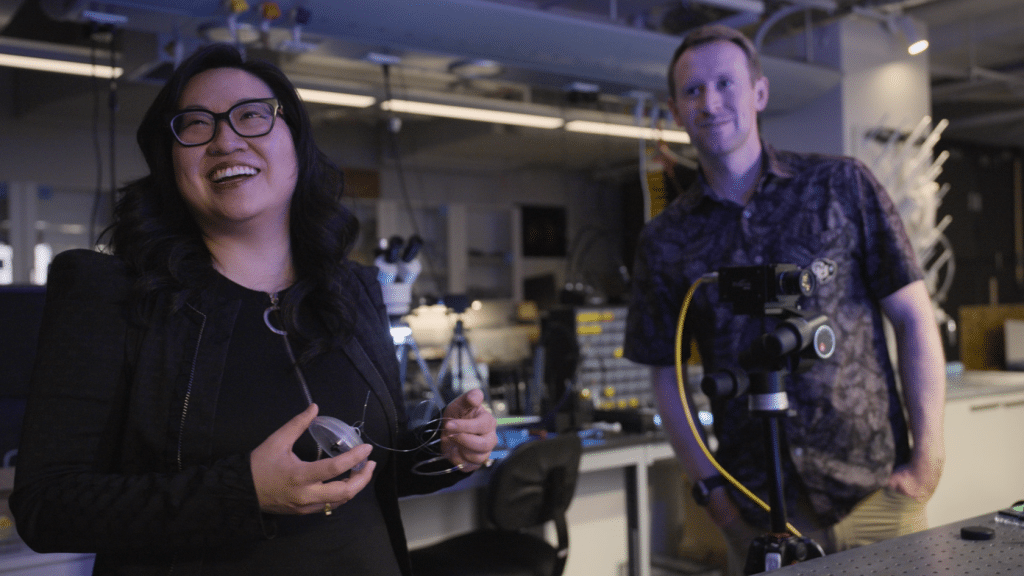
Inspired by creatures like jellyfish, sharks, and rays that already navigate the ocean with ease, Nicole Xu, a 2025 Packard Fellow at the University of Colorado Boulder, and her team are building bio-inspired robots to monitor the ocean and track the effects of climate change. These robots could one day document changes in ocean temperature or acidity driven by rising levels of carbon dioxide absorbed from the atmosphere.
With the ocean producing half of the Earth’s oxygen, supporting a wide variety of marine life, regulating our climate, and providing food and jobs for billions of people, it’s important to understand how it’s changing. Better tools for monitoring ocean health can deepen our understanding of how human activities are impacting nature and inform programs and policies to protect and restore the ocean for the communities and ecosystems that depend on it.
Some of these robots mimic fish fins and incorporate the texture of shark skin to reduce drag and improve propulsion. Others are modeled after the highly energy efficient swimming movement of jellyfish. Her lab is working on a pacemaker-like device that attaches to a live jellyfish to control its swimming direction and speed. These jellyfish could eventually carry sensors measuring water temperature or pH to places in the ocean that traditional vehicles can’t efficiently reach.
"The ocean is so big and there's so much that we don't know. We really need to use all the different tools and technologies possible."
Nicole Xu, 2025 Packard Fellow
In pursuit of creative new approaches for underwater tools, Xu’s team recently discovered a jellyfish swimming behavior they’ve dubbed “hula hooping.” They are studying whether this movement increases speed or energy efficiency, and how to replicate it in robots.
The Packard Fellowships for Science and Engineering provide $875,000 over five years to promising early career scientists like Xu. The Fellowships were inspired by David Packard’s passion for science and engineering and his commitment to strengthening university-based science and engineering programs in the United States. Recognizing that the success of the Hewlett-Packard Company, which he co-founded, grew from breakthroughs in university labs, the Fellowships were founded to seed the experimentation and discoveries that would lead to the innovations of the future.
The funds are unrestricted, so Fellows can pursue new ideas with complete flexibility. For Xu, that’s meant freedom to explore high-risk projects without proven applications, like growing corals and sea sponges in the lab using tissue engineering for potential habitat restoration.
“It’s important to support early career scientists because we don’t have the track record that established scientists already have,” said Xu. “It’s really great to have the freedom and flexibility of the Packard Fellowship so that we can explore these new areas and branch out into new interdisciplinary projects.”
Xu and her team hope to eventually test her robots in the deep waters of the Mariana Trench. By supporting scientists like Xu, the Packard Foundation supports partners working to ensure a healthy ocean that sustains communities now and for generations to come.